 Facebook
 Twitter


 Gmail
Sebastiaen Vrancx
(Antwerp 1573 - Antwerp 1647)
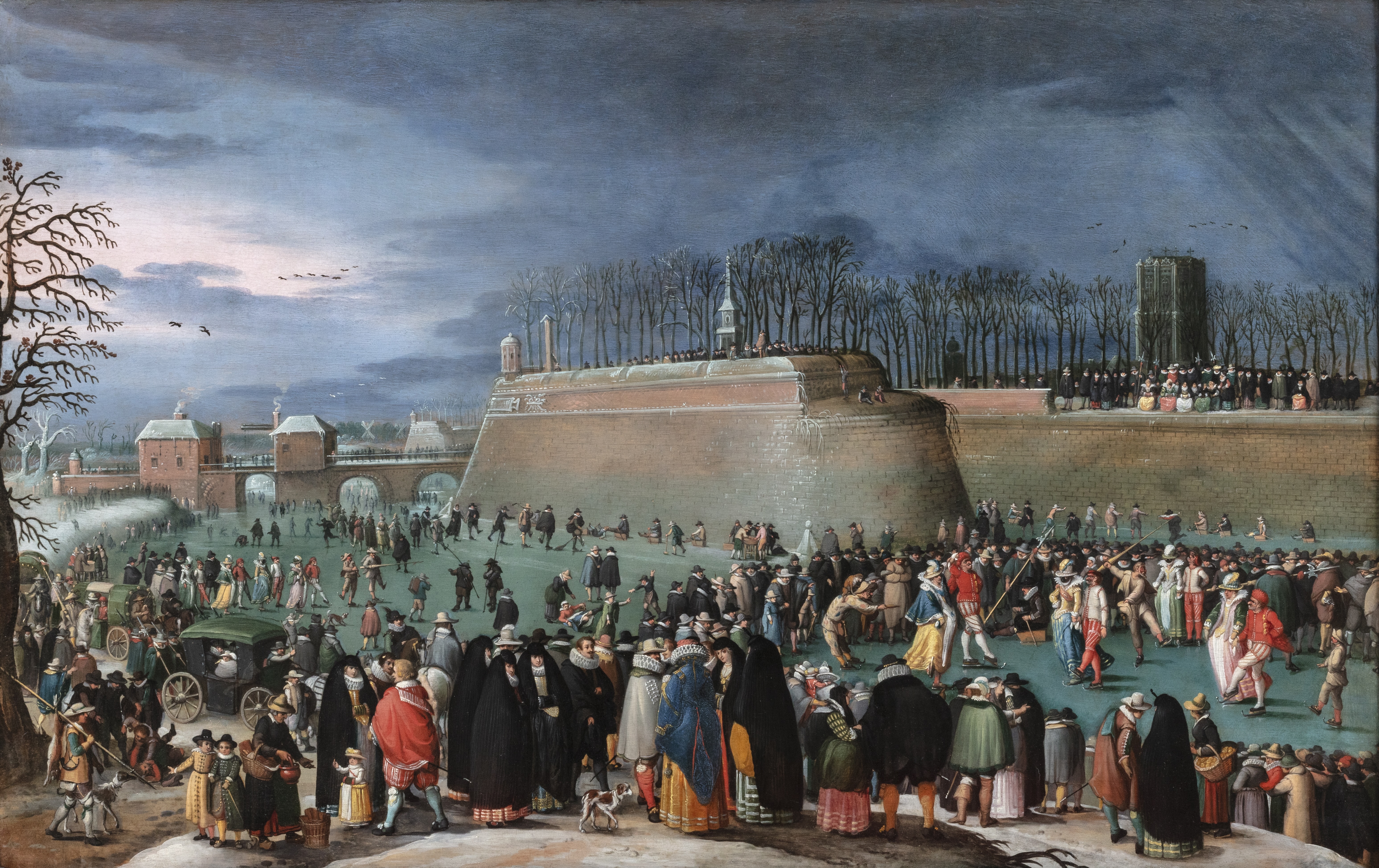
Winter Carnival with Ice Skaters in front of the Kipdorppoort Bastion in Antwerp
Count Adalbert von Sandor von Sziavnicza (1889-1972), senior civil servant and cavalry captain, Vienna.
Private Collection in Vienna, and thence by descent.
...
In front of the city walls of Antwerp, near the Dipdorppoort, a large number of people of different classes are depicted, and they cavort on the frozen city moat. Such public festivals and attractions were very popular in Antwerp, and, at the same time, provided an almost unlimited visual source of inspiration for local artists. Meticulous depictions of the multi-colored ...
The present composition had traditionally been associated with Denijs van Alsloot, to whom several versions have been attributed, including ones in the Museo Nacional del Prado and in the Bavarian State Collections. However, in her 2014 monograph on Denijs van Alsloot, Sabine van Sprang rejected these attributions (see Sabine van Sprang, Denijs van Alsloot, Peintre Paysagiste au service de la cour des Archducs Albert et Isabelle, Turnhout 2014, p. 355). In current art historical research, Sebastian Vrancx is regarded as the creator of this composition.
The present panel, which has been in private collections, is close to the well-known compositions. Above all, the varied arrangement of the figures in the foreground and middle ground, as well as the details of their positions and physiognomies indicate that this is a previously unknown, autograph variation by Vrancx. Furthermore, this painting, owned by Adalbert von Sandor Von Szlavnicza, is the largest of the known works.
The details seen in the present painting are entirely consistent with what one sees in Vrancx’s best works, both in the spirited figure painting, the rendering of the architecture, and the device of the tree framing the scene on the left side. This has allowed it to be securely attributed to Vrancx, with a possible date around 1618-20.
The subject shows a large and colorful crowd of revelers, many in carnival costume, converging on the frozen moat around Antwerp’s city walls near the Kipdoorpoort. The scene was borne out of the local enthusiasm for orchestrated public festivities, which took place to different degrees throughout the year in Antwerp, the largest and most spectacular of all being the Ommegang held on Pentecost, which also provided a rich visual source for artists. Masked entertainers, dancers, musicians, and rhetoricians made up a rich array of entertainers at these events and a performance on ice by a cast from the Commedia dell’Arte forms the star attraction in this example. By Breughelian standards the festivities are relatively restrained and those attending are notable for their elegance. People from across the whole social spectrum, rich and poor, mix happily together on the ice affirming the notion that these types of carnivals had the effect of temporarily diverting the attentions of the most disenfranchised and dissipating social tensions. These public celebrations were carefully monitored by the authorities to whom all songs and performances had to be submitted for approval. A congregation of local clerics and other dignitaries above on the ramparts, who are deliberately aligned with the rather overbearing church tower behind, reflect this more sober, supervisory view of the party below. An active group of Antwerp painters were active in the carnival tradition; elegant images of balls, nocturnal fêtes and masquerades featured in the repertoire of several artists such as Joos van Winge, Louis de Caullery, Hieronymous Francken and Frans Francken II, who all drew inspiration from Venetian themes. Many of these artists were closely affiliated with the actors who performed in public, and Vrancx himself was a member of de Violieren, an official chamber of Antwerp rhetoricians which was allied to the St. Luke’s Guild.
In front of the city walls of Antwerp, near the Dipdorppoort, a large number of people of different classes are depicted, and they cavort on the frozen city moat. Such public festivals and attractions were very popular in Antwerp, and, at the same time, provided an almost unlimited visual source of inspiration for local artists. Meticulous depictions of the multi-colored small groups of figures reveal a great variety of characters: In the foreground, the elegantly dressed figures in very fancy clothing and with overflowing neck ruffles stand out. Between them there are food sellers, a young man and, on the left edge of the picture, even a group of up-and-comers. On the city wall on the right, partly seated, a group of clergymen and other people is depicted, while on the ice the most diverse games and dances can be recognized. However, the "Commedia dell'Arte" troupe performing its magnificent masquerade, positioned in the right-side of the picture, attracts the attention of those who were there at that time – and of today's viewer as well. The architecture of Antwerp is also recognisable above the city walls: the square tower of the Sint Jacobs Church rises monumentally. In the 19th century, the original fortifications, and walls in Antwerp, including the Kipdorp Gate and the bridge of the same name (Kipdorppoort andKipdorpbrug), were demolished or levelled in favor of modern urban expansion. However, on the Antwerp plan by Virgilius Bononiensis, dated 1565, the exact point of view of the painter can still be seen today.
You may also like
Pieter Claesz
(Berchem 1597 - Haarlem 1661)
“A Still Life with a Gilt Tazza, Pewter Jug, and a Fluted Wine Glass”
Sebastiaen Vrancx
(Antwerp 1573 - Antwerp 1647)
“Winter Carnival with Ice Skaters in front of the Kipdorppoort Bastion in Antwerp”


