 Facebook
 Twitter


 Gmail
Jacob Jordaens
(Antwerp 1593 - Antwerp 1678)
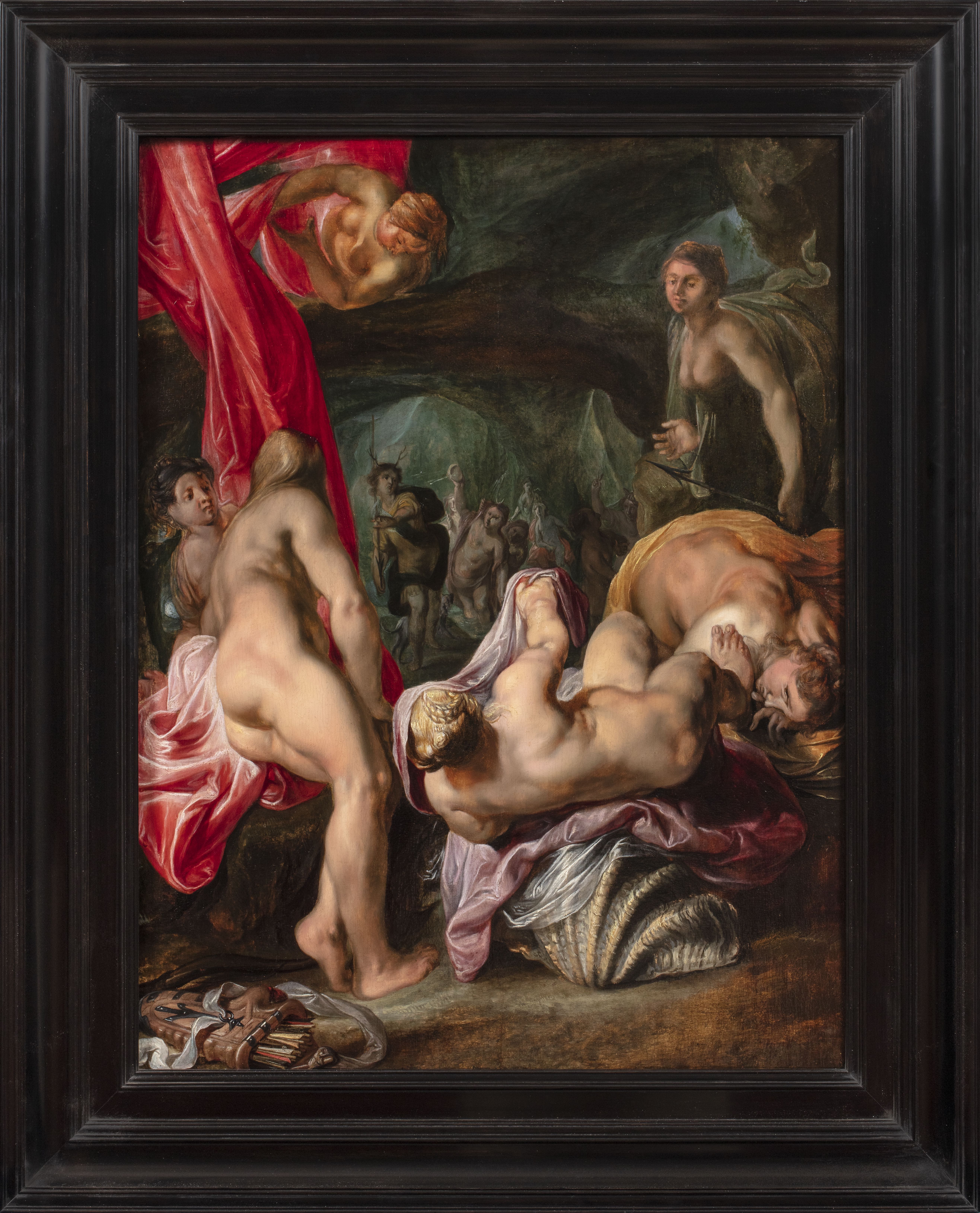
Diana and Actaeon
Collection of Jean Baptiste Boyer d'Aguilles (1650-1709);
On the London art market in the late 1930s;
Acquired by Feliks Topolski, c. 1950;
Anonymous sale ("Property from a Private Collection"), Sotheby's London, 5 July 2012, lot 236 (as Antwerp School, second decade of the 17th century);
In the collection of Jonathan Richardson, London and N ...
A.Tzeutschler Lurie, in Johann Liss, exhibition catalogue, Augsburg 1975/76, pp. 65-68, cat. no. A8, reproduced fig. 6 (as Johann Liss);
J. Rowlands, “’Johann Liss at Augsburg”, in The Burlington Magazine, vol.CXVII, no. 873, 1975, pp. 832 and 835 (where an attribution to the young Liss is discussed);
R. Spear, “Johann Liss Reconsidered”, ...
R. Klessmann, Johan Liss. A Monograph and Catalogue Raisonné, Ghent 1999, p. 193 (as Unknown Flemish Master’; under Selection of Works Incorrectly Attributed to Liss).
Augsburg, Rathaus; Cleveland, Cleveland Museum of Art, Johann Liss, 2 August 1975 – 7 March 1976, no A8 (as Johann Liss).
...
This painting constitutes an important new addition to the oeuvre of Jacques Jordaens (Antwerp 1593-1678). He was one of the three most famous baroque Flemish painters, together with Sir Peter Paul Rubens (Siegen 1577-Antwerp 1640) and Sir Anthony Van Dyck (Antwerp 1599 – London 1641). Jordaens had the longest career, surviving his two colleagues by almost four decades. But amongst these ...
A French reproduction print from 1700 (fig. ) by Jacob Coelemans attributed the painting to Rubens’s last master, Otto van Veen (Leiden 1556 – Brussels 1629). At that moment Jordaens was not that well known any more in France which makes such mistake quite understandable. Moreover, the baroque opulence of this picture is quite different from the austere and rather intellectual style of Van Veen, an erudite painter who went under the latinized name of Vaenius. As the abovementioned literature explains, several art historians have tentatively attributed this Diana and Actaeon to Johann Liss (Oldenbourg 1597-Verona 1631). In hindsight they became more hesitating, remarking that its style stands out from the rest of Liss’s oeuvre. In the most recent monograph on Liss, Rudiger Klessmann explicitly refuted the attribution to that German master after having initially endorsed the attribution to Liss when collaborating on the 1975/76 catalogue. Strangely enough, several of these scholars commented on striking parallels with the works of Jordaens but did not make the logical conclusion that this painting is instead by Jordaens’s hand. This scholarly ‘myopy’ is probably also due to the one-dimensional perception of Jordaens that dominated scholarly literature on this Flemish master for so long. In that one-sided tradition he was seen almost exclusively as the bourgeois master of genre-like scenes like ‘The King drinks!’ and ‘So the old sang, so pipe the young’. Therefore these scholars may have been biassed by the fact that this picture has a mythological subject. Only recently did Jordaens scholarship challenge the traditional reductive appreciation of a jolly Jordaens by pointing to the important impact of antiquity on his oeuvre and the original way in which he treated antique sources - even when compared to Rubens. This is also the case with this picture which offers in addition both material, chronological and stylistic evidence for the fact that it has been painted by the young Jordaens.
The dimensions of the wooden support point to a specific standard measure typical for the painting practice in the Netherlands during the 17th century: the ‘zesstuivers maat’ (the six pennies measure) which was particularly popular in Antwerp. The construction with two taped and thin planks of expensive quarter sawn oak from the Baltic is also in accordance with the best practices and severe regulations for panel makers in Antwerp. Moreover, an analysis by dendrochronology of the growing rings of the wood used for the panel, established that the two planks are from the same tree, the felling date of which could be established as after 1608. Needing some more two more years in transport and drying to become a painting support, this brings us to a date after 1610 for the painting proper. This is relevant because the young Jordaens became a free-master in the Antwerp painter’s-guild in the guild year that started on 18 October 1615, the feast of the painters’s patron St Luke. It is in his works from the first years of his career as a free-master till about 1618 that convincing parallels can be found with this painting in terms of style and of a particular use of artistic sources. The bulk of those early paintings has been assembled by Roger – A. d’Hulst, whereas a significant number of the early panels have been studied again in the flesh in recent times by the Jordaens Van Dyck Panel Paintings Project.
Jordaens has never been in Italy. But he was well acquainted with the antique culture via indirect sources like translations of antique Latin authors, or print series and statuettes in Antwerp collections reproducing antique sculpture. There are also clear indications that he got access to drawings by Antwerp masters who had been studying antique art south of the Alps like Abraham Janssen and Peter Paul Rubens. More and more evidence indicates that Jordaens must have been active in the Rubens studio as a collaborator already quite early on. This indirect acquaintance with the antique explains why this painting follows in quite some detail the text in Ovid’s Metamorphoses on Actaeon’s forbidden sight of the nude goddess Diana and her nymphs and his terrible punishment by being transformed by her into a deer to be devoured by his own hunting dogs.24 At the same time Jordaens’s faithful rendering of Ovid’s text results in some quite original compositional choices, because influential earlier images of this story, both south of the Alps with the famous painting by Titian for Prince Philip of Spain or the many representations in mannerist prints north of the Alps in Haarlem and Utrecht, do not render the grotto as a backdrop which Ovid describes as the resting place of Diana and her companions. This said, Jordaens is well acquainted with the visual tradition. Like his master Adam van Noort in his Preaching of John the Baptist from 1601 (Antwerp, Museum Rubens House), he puts repoussoir figures on both sides on the foreground, leaving the center background more empty, a device that Carel van Mander will soon mention in his influential Schilderboeck as an example to be followed by youthful artists. Jordaens is also well acquainted with the expressive poses of figures in movement by northern mannerists, like in Joseph Heintz’s rendering of the same theme reproduced in an engraving by Aegidius Sadeler; or in Joachim Wtewael’s Jupiter and Danaë now in the Louvre. Other influences and the way they are processed are also typical for Jordaens. In the nymph who is completely bended over on the foreground right, one recognizes a citation of the bottom figure in the famous antique sculpture group of The Wrestlers. Jordaens may have been inspired by the alternative citation of the figure lying on top in the same Roman sculpture in Rubens’s Massacre of the Innocents from about 1610 (Toronto, The Thomson Collection at the Art Gallery of Ontario 2014). This early Rubens shows an analogous vehement scene with monumental nudes. There one also finds the intricate, antique inspired, female hairdress of the monumental Jordaens nymph seen on the back on the foreground. Jordaens’s On the other hand, the figure of the nymph wearing a javelin on the middle ground right is clearly inspired in its pose and simplified physiognomy by a reproduction print from his series after public antique sculptures in Rome by the Roman print publisher Andrea Vaccari (Rome 1578-1627) of Niobe protecting one of her daughters. This sculpture was part of the famous antique ensemble of statues of the Niobids, daughters of Niobe; who were killed by Artemis and Apollo because Niobe considered the beauty of her offspring greater than that of Leto, the mother of both gods. This reputed group was once to be seen in the garden of the Villa Medici in Rome. The use of such simple reproduction prints as indirect antique sources is typical for Jordaens and can also be found in his early Nymphs and Satyrs (A Tribute to Pomona - Allegory of Fertility) now in the Bass Museum of Art in Miami. The nymph hovering in the air in the upper right corner is a device originally found in the paintings of Caravaggio. But it has also inspired Rubens in several of his early versions of the Adoration of the Shepherds, both during his Italian stay (for Fermo) and soon after his return in Antwerp in the Dominican church (nowadays the Antwerp church of St Paul). Its reworking by Jordaens in his typical early style is also to be found in his Return of the Holy Family from Egypt (Rhode Island School of Design, Providence, USA) and in the Allegory of Fertility (Bacchus and his train in a drunken revel) once in the Nardus collection. Typical as well for the early Jordaens in this Diana and Actaeon is the treatment of space with its rather abrupt transition from the monumental figures in the foreground to the figures in the background who are both far smaller, far more vague in their contours and far less colourful. Those characteristics, as well as the vehement poses, can also be found in Jordaens’s early Abduction of Europe (whereabouts unknown) and in the Lapiths and Centaurs, from the Jaffé estate, once on loan to the Fitzwilliam Museum in Cambridge but now in the collection of the Phoebus Foundation in Antwerp. In those other early Jordaens paintings more general parallels are to be found in the colour scheme with reds and pink mauves contrasting with grey and brown hues in the background, as well as in the intricate contortions of the anatomy, the simplified faces, the pinkish carnations and the articulation of the draperies.
The points of comparison with Jordaens’s early works are so abundant and manifold that there can be no doubt that this panel painting, moderate in scale but ambitious in composition, is from the hand of a youthful Jordaens.
*Dr. Joost Vander Auwera
This painting constitutes an important new addition to the oeuvre of Jacques Jordaens (Antwerp 1593-1678). He was one of the three most famous baroque Flemish painters, together with Sir Peter Paul Rubens (Siegen 1577-Antwerp 1640) and Sir Anthony Van Dyck (Antwerp 1599 – London 1641). Jordaens had the longest career, surviving his two colleagues by almost four decades. But amongst these three artists he was also the one least well studied. That is until the last decade when a rise of scholarly focus on his life and work yielded new and surprising conclusions as to the originality and versatility of his oeuvre. This is particularly true for his earlier years when his style was rapidly evolving and still differed from his better-known idiom from the 1620s onwards, as remarked by the famous Jordaens scholar, the late Roger-A. d’Hulst. It does therefore neither come as a surprise that the author of this entry could add very recently new insights as to the chronology and evolution of the young Jordaens, nor that quite some youthful works by his hand are still being discovered, going previously under erroneous attributions, as is the case for the painting in question.
You may also like
Pieter Claesz
(Berchem 1597 - Haarlem 1661)
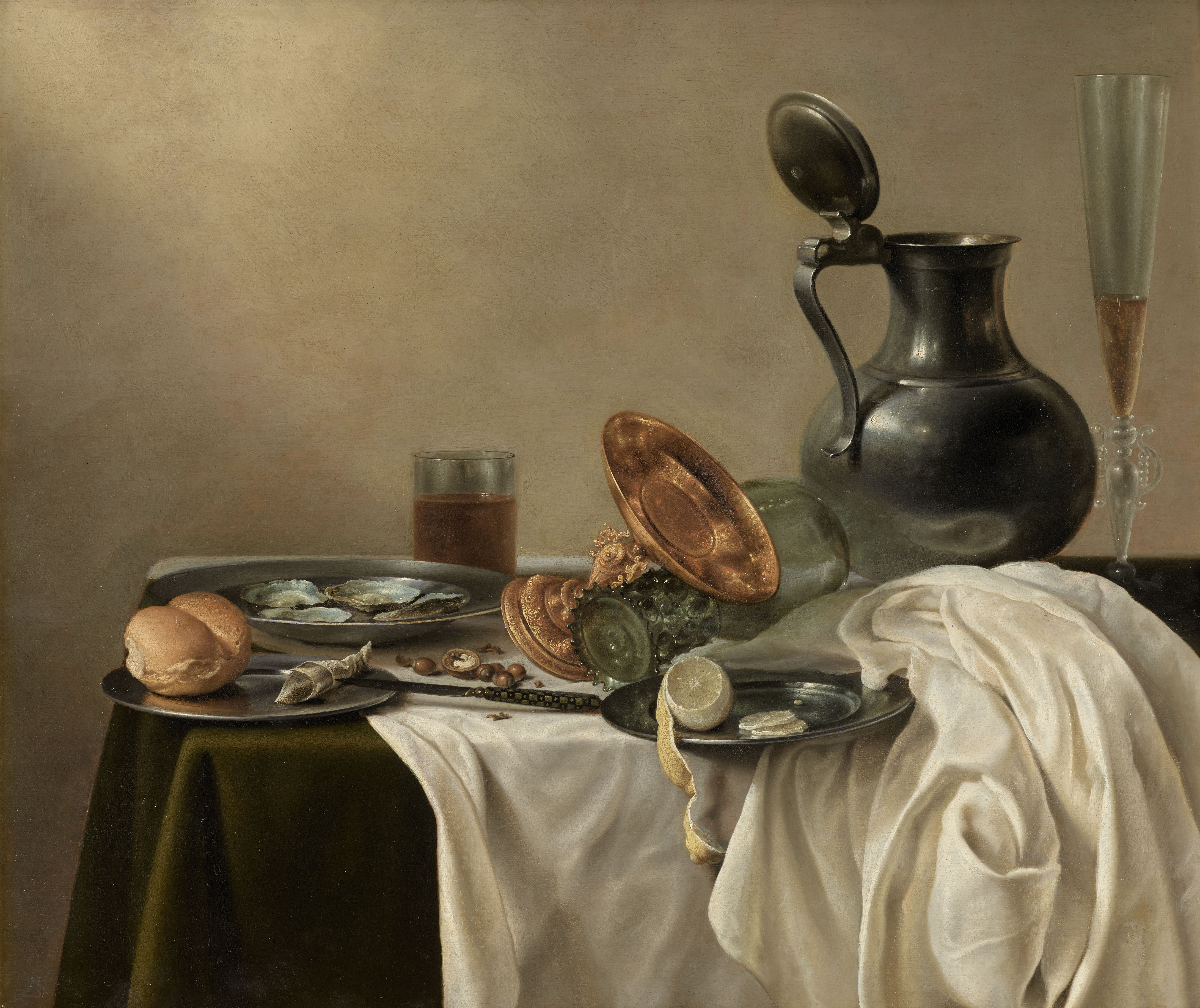
“A Still Life with a Gilt Tazza, Pewter Jug, and a Fluted Wine Glass”
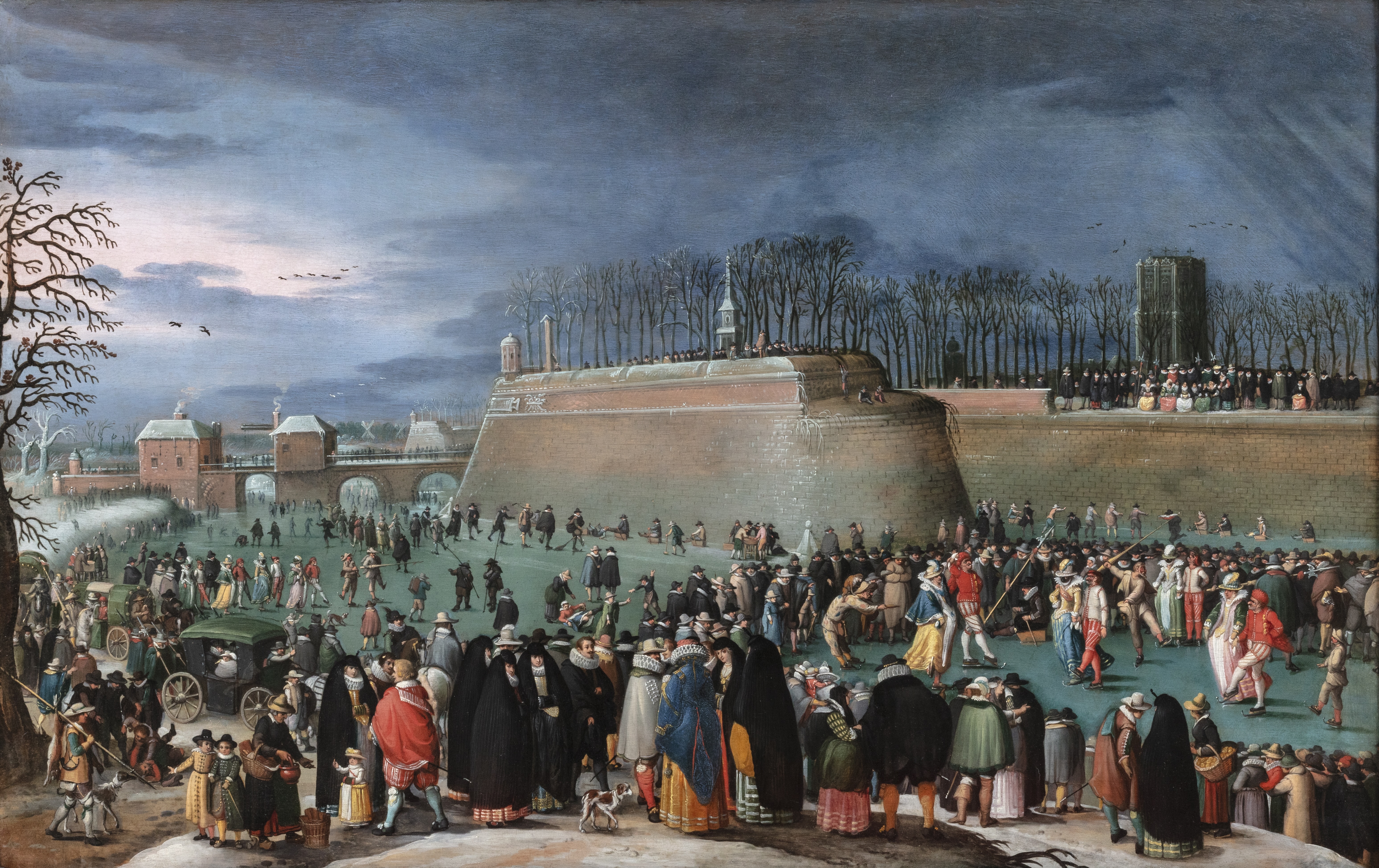
Sebastiaen Vrancx
(Antwerp 1573 - Antwerp 1647)
“Winter Carnival with Ice Skaters in front of the Kipdorppoort Bastion in Antwerp”


