Facebook
 Twitter


 Gmail
Jacopo Negretti, Palma il Vecchio
(Serina, near Bergamo 1480 - Venice 1528)
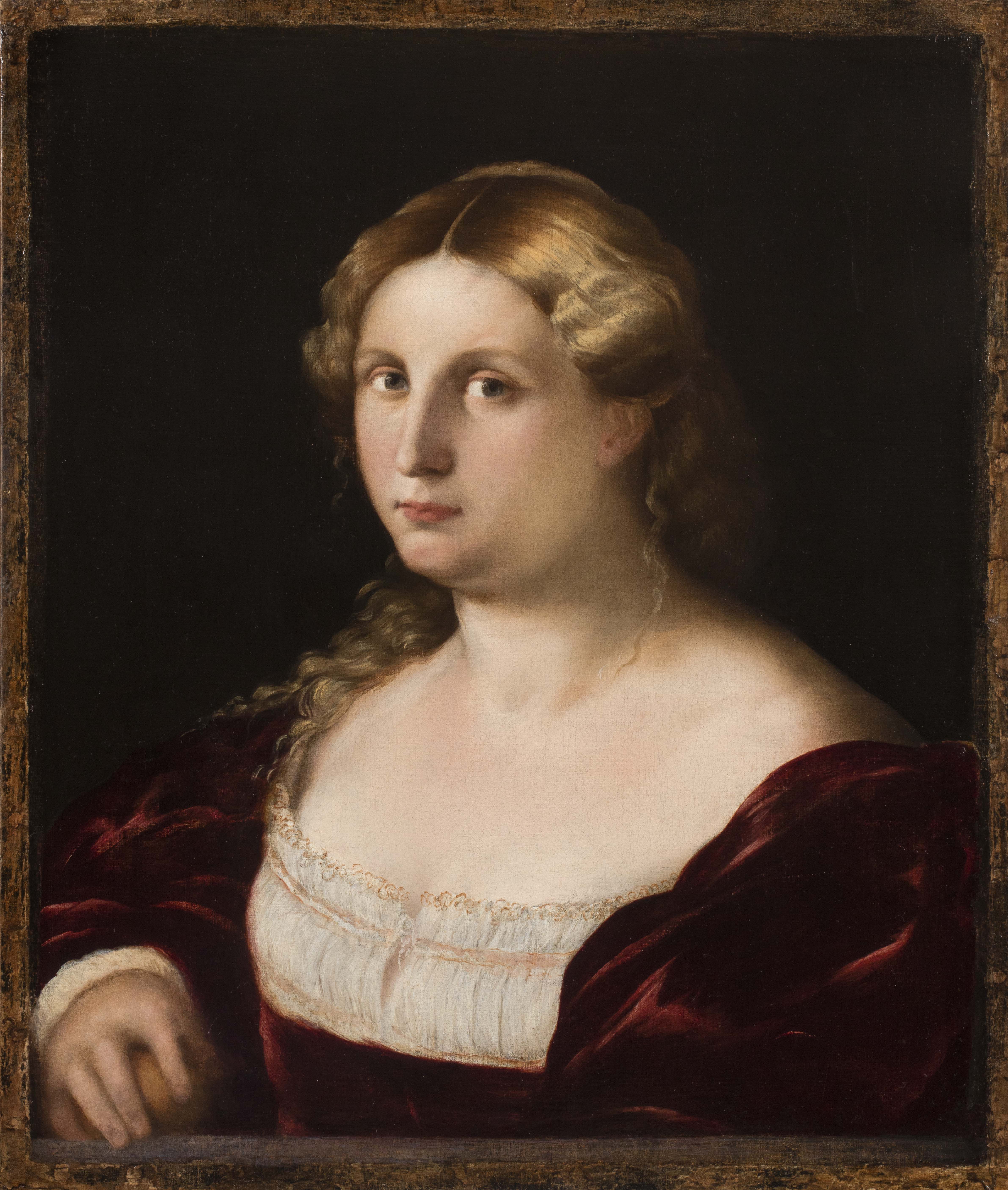
Portrait of a Lady, bust-length, in a white shirt and red dress, holding a piece of fruit
(Probably) Recorded in the artist's studio at the time of his death in 1529 ('I quareto de un retrato de una d. de q.2 in ca., con vesta de veludocremesin con un pomo in man [13]';
Girolamo Manfrin (1742-1801), Venice, as 'Paris Bordone', and by descent to his son;
Pietro Manfrin (d. 1833), as 'Paris Bordone', and by inheritance to his sister;
...
(Probably) P. Edwards, Inventario della Galleria Manfrin, 1794, MS.1032.18, SPV, no. 30, as ‘Paris Bordone Ritratto, si crede del detto autore’.
Inventario e stima della Galleria Manfrin, 23 March 1834, MS. ASVe, Conservatoria del registro e tasse, Venice, no. 11, as ‘Tela Paris Bordone, Ritratto di donna, 500,000’.
Inventory ...
, 1851, MS. NG72/48/2, National Gallery, London, no. 11, as ‘Paris Bordone Ritratto di Donne’, listed in ‘Stanza Segnata B’.
Catalogo dei Quadri esistenti nella Galleria Manfrin in Venezia, Venice, 1856, no. 93, as ‘idem [Ritratto] di Donna, Paris Bordone, Tela, 50 x 59’.
F. Zanotto, Nuovissima Guida di Venezia e delle Isole della sua Laguna, Venice, 1856, p. 343, as ‘Ritratto della Violante figlia del Palma Vecchio – di Paris Bordone’.
A Catalogue of the Pictures at Canford Manor, Dorchester, 1888, p. 10, no. 17, as ‘Paris Bordone’.
Masters in Art, Venetian School: Palma Vecchio, Boston, 1905, p. 41.
P. Rylands, Palma Il Vecchio: L’opera completa, Milan, 1988, pp. 41 and 213, no. 36, erroneously catalogued as on panel and in a private collection, Paris.
P. Rylands, Palma Vecchio, Cambridge, 1992, pp. 98 and 178, illustrated, erroneously catalogued as on panel and in a private collection, Paris.
G. Pavanello, ed., Gli Inventari di Pietro Edwards nella Biblioteca del Seminario Patriarcale di Venezia, Verona, 2006, p. 77.
P. Benussi, ‘Documenti’, in L. Borean, ed., La Galleria Manfrin a Venezia: L’ultima collezione d’arte della Serenissima, Udine, 2018, pp. 92, 106 and 128.
London, Royal Academy, Italian Art and Britain, 1960, no. 66, erroneously catalogued as on panel.
...
It is a testament to Palma il Vecchio’s assimilation of Venetian colorito that Giorgio Vasari (1511-1574) mistakes him for Venetian, though he was in fact born near Bergamo on the terrafirma. That penchant for deeply vibrant coloring, representative of the Venetian school of painting, is on full display in the present painting, where the sitter’s lu ...
While some scholars have hypothesized that the sitter was the artist’s daughter Violante (Zanotto, op. cit., 1856), her resemblance to the many other belle donne painted by Palma and his Venetian contemporaries suggests that, rather than a portrait of a specific woman, the present work was intended to represent the ideals of beauty. The golden apple in her hand alludes to her identity as the very goddess of beauty, Venus, who won such a prize in the infamous Judgement of Paris. Her direct gaze and enigmatic expression may thus imply a recognition for the role she played in the inciting incident of the Trojan War.
The earliest documentation for Palma’s career situates him already in Venice by March 1510, where he was exposed to works by Venetian masters such as Giovanni Bellini (1430-1516), perhaps under the tutelage and eye of Andrea Previtali (1480-1528), one of Bellini’s students. As Titian (c. 1488/1490-1576) rose in popularity, Palma’s style developed to match and even challenge his contemporary. The present work, with its hazy sfumato and rich textures, is suggestive of the ways in which Palma and Titian pushed each other and Venetian colorito to new depths.
Palma’s Venetian Venus is believed to be the painting listed in the posthumous inventory of the artist’s studio as “una d[onna]…con vesta de veludocremesin con un pomo in man” (a woman with a crimson velvent dress with an apple in hand), though the dimensions of that painting and the present work vary (Rylands 1992, p. 350, no. 13). Nonetheless, the specificity of the description and its close match to the present work are quite suggestive. It was subsequently acquired by Marchese Girolamo Manfrin (1742-1801), a financier and tobacco magnate who amassed a renowned collection of artworks to decorate Palazzo Venier (renamed Palazzo Manfrin), which he acquired in 1787. While in the Manfrin collection, the present work was attributed to Paris Bordone (1500-1571), a student of Titian. This painting remained in the Manfrin Collection until 1868, when it was purchased by an ancestor of the previous owner.
It is a testament to Palma il Vecchio’s assimilation of Venetian colorito that Giorgio Vasari (1511-1574) mistakes him for Venetian, though he was in fact born near Bergamo on the terrafirma. That penchant for deeply vibrant coloring, representative of the Venetian school of painting, is on full display in the present painting, where the sitter’s lush crimson gown and golden hair attracts the light. The unknown woman – the very archetype of Venetian beauty, with golden hair, pale skin, thin eyebrows, and plump features – gazes out at us, her dark eyes intelligently seeking us out. Her hair cascades around her, the golden locks framing her face. A white chemise, embroidered with gold, complements the deep red of her gown, whose velvety smoothness seems tangible even rendered in paint. Her right hand holds a golden apple, tenuously grasped in her palm even as two fingers rest on a ledge barely visible in the foreground of the painting.
You may also like
Jacopo Negretti, Palma il Vecchio
(Serina, near Bergamo 1480 - Venice 1528)
“Portrait of a Lady, bust-length, in a white shirt and red dress, holding a piece of fruit”