 Facebook
 Twitter


 Gmail
Domenico Fetti
(Rome 1589 - Venice 1623)
David with the Head of Goliath
A bishop of the Fracassetti family, Venice (according to a seal on the reverse of the canvas);
Anonymous sale; Christie’s, London, 9 July 2008, lot 147,
Anonymous sale; Christie’s, New York, 30 October 2018, lot 37;
Private Collection.
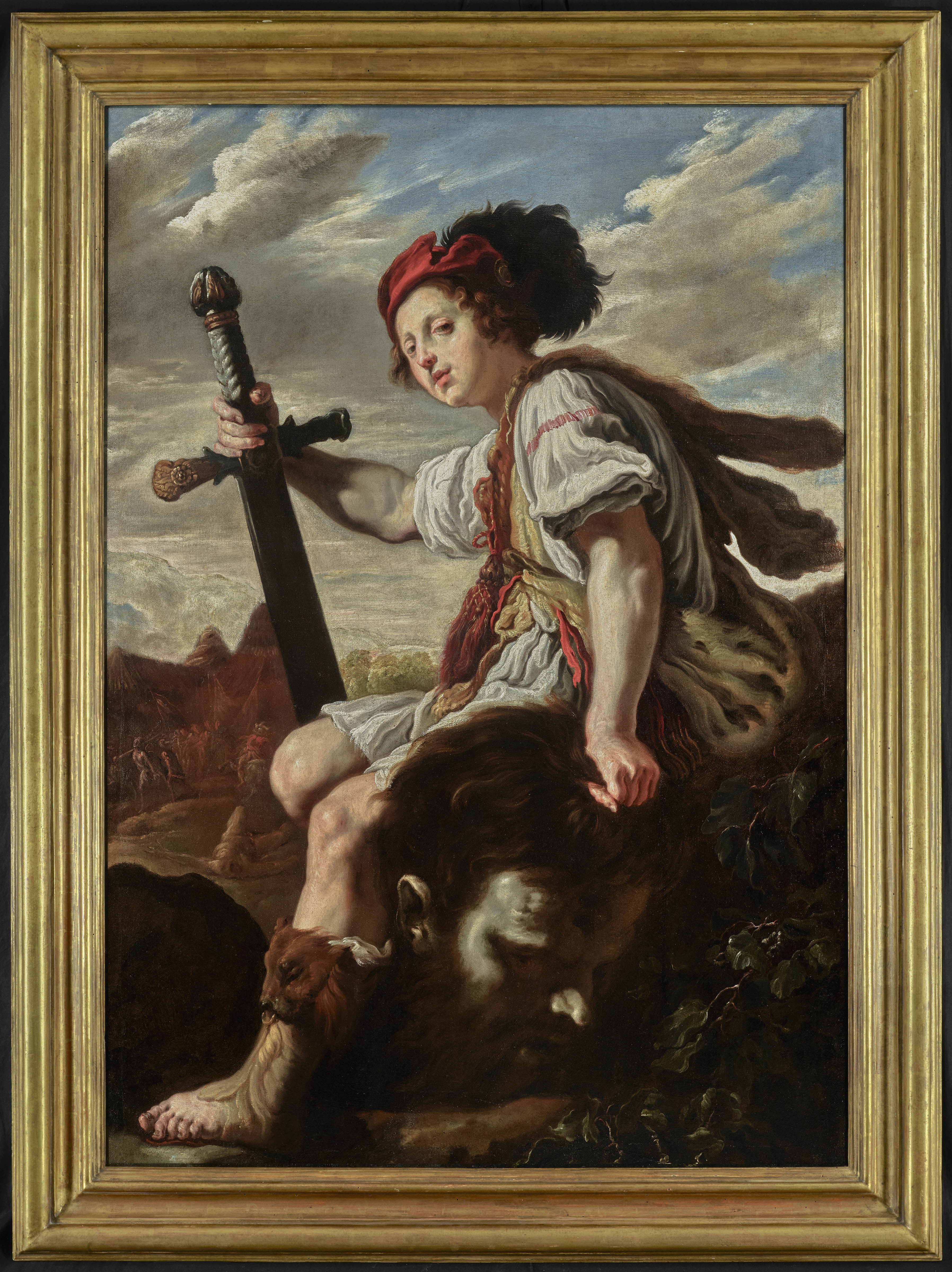
This David with the Head of Goliath is one of a number of versions of Domenico Fetti’s most enduringly popular composition. A self-assured young David pauses for a moment of rest following his battle with the giant Goliath. The red accents of his clothing – the elaborate red and gold tassel, embroidery on his sleeve, his jaunty cap – suggest the violence of ...
This work is one of at least five autograph versions of the composition produced by Fetti. Closely related versions are held in the Royal Collection, UK, the Gemäldegalerie Alte Meister in Dresden, and the Nationalmuseum, Stockholm, with a preparatory drawing at the J. Paul Getty Museum, Los Angeles. Eduard Safarik, writing in 2008, considered the present work to be among the best of the known variants. Two half-length iterations are at the Akademie der Bildenden Künste, Nuremberg, and the Pushkin Museum of Fine Arts, Moscow, and a third variation, demonstrating the influence of his later stay in Venice, is at the Gallerie dell’Accademia, Venice. More than fifteen variants – produced by Fetti, his workshop, or some combination of the two – have been recorded to date, suggesting the lasting popularity of this theme and composition.
The present work, along with the other known iterations of Fetti’s David with the Head of Goliath, is associated with the artist’s tenure as court painter to the Gonzaga family in Mantua (1614-1622). Fetti and Cardinal Ferdinando Gonzaga (1587-1626, later Duke Ferdinando II Gonzaga) had a well-established relationship by 1611, when the two men were residing in Rome. Ferdinando’s account books record that while in Rome he had already begun commissioning work from Fetti, alongside other artists in Fetti’s circle. When Ferdinando’s elder brother died in December 1612, the young cardinal suddenly became the heir apparent for the ducal throne. Ferdinando returned from Rome to Mantua, where he was formally appointed Ferdinando II, the 6th Duke of Mantua. Fetti followed him north shortly thereafter, becoming court painter in early 1614.
That the David should be linked to Fetti’s residency in Mantua is suggested as we see the hero dressed in the Gonzagan colors: a black feather in his cap, reminiscent of the four eagles that adorned their crest; the red cap and ornamentation on his dress; the gilded embellishments on the sword-hilt and the golden pelt wrapped around his chest. Furthermore, scholars have suggested that the visage of David bears the features of Duke Ferdinando. This work, then, offered up a new vision for Mantua under Ferdinando’s rule: biblical authority in combination with military might.
This David with the Head of Goliath is one of a number of versions of Domenico Fetti’s most enduringly popular composition. A self-assured young David pauses for a moment of rest following his battle with the giant Goliath. The red accents of his clothing – the elaborate red and gold tassel, embroidery on his sleeve, his jaunty cap – suggest the violence of battle, but his white tunic remains clean. In fact, there is no blood to be found at all: not on the oversized sword, nor on Goliath’s decapitated head; there is only the flush on David’s cheeks and hands to suggest the fading rush of adrenaline. In the background, Goliath’s corpse remains on the ground, surrounded by a war camp bathed in a red haze as the Israelites finish their attack on the Philistine camp. Seated apart from the commotion, Fetti’s David is a confident and powerful victor who brought down the giant with ease, who will one day be king, who now looks out at the viewer as if daring us to challenge him once more.
You may also like
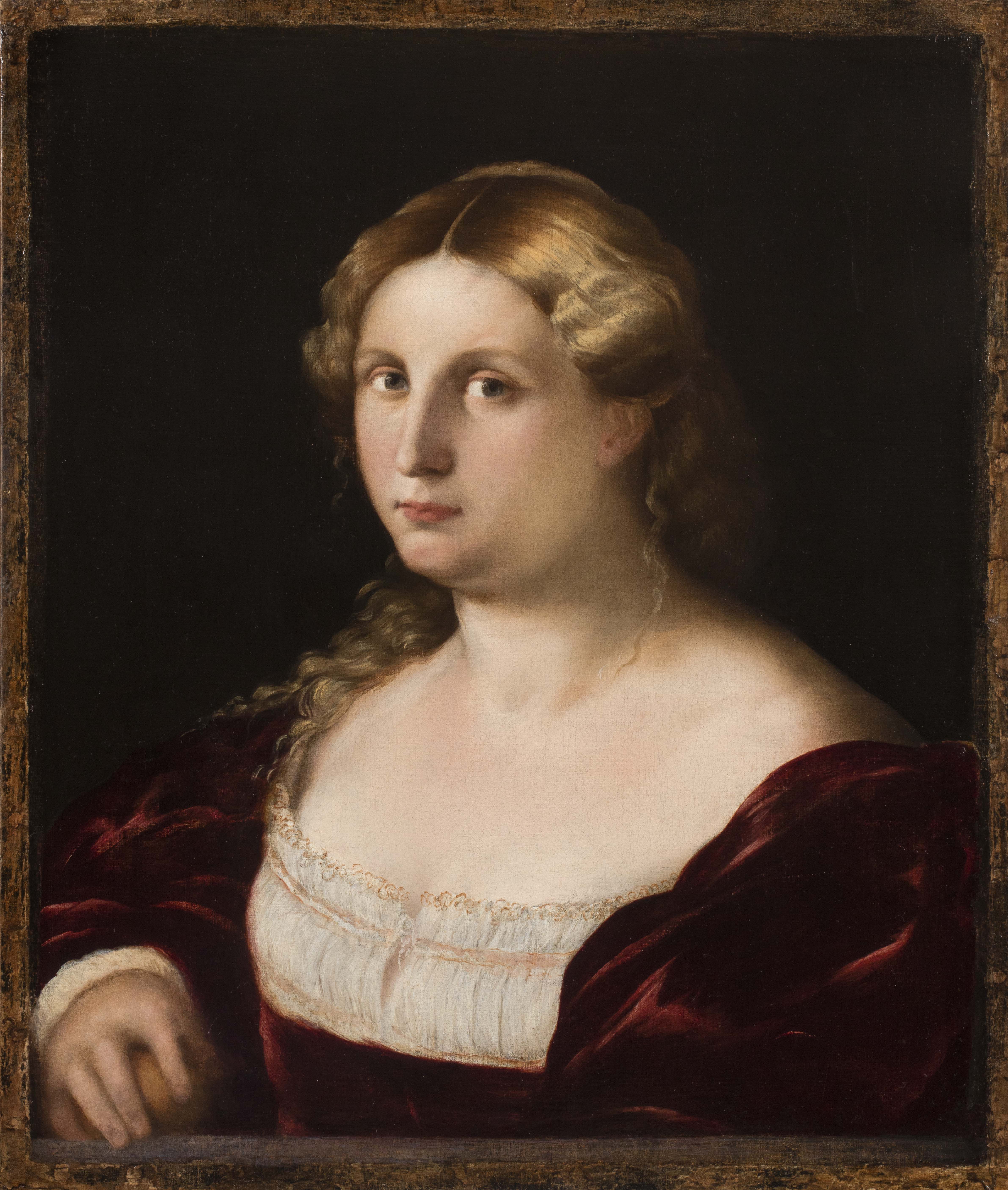
Jacopo Negretti, Palma il Vecchio
(Serina, near Bergamo 1480 - Venice 1528)
“Portrait of a Lady, bust-length, in a white shirt and red dress, holding a piece of fruit”