 Facebook
 Twitter


 Gmail
Pieter Claesz
(Berchem 1597 - Haarlem 1661)
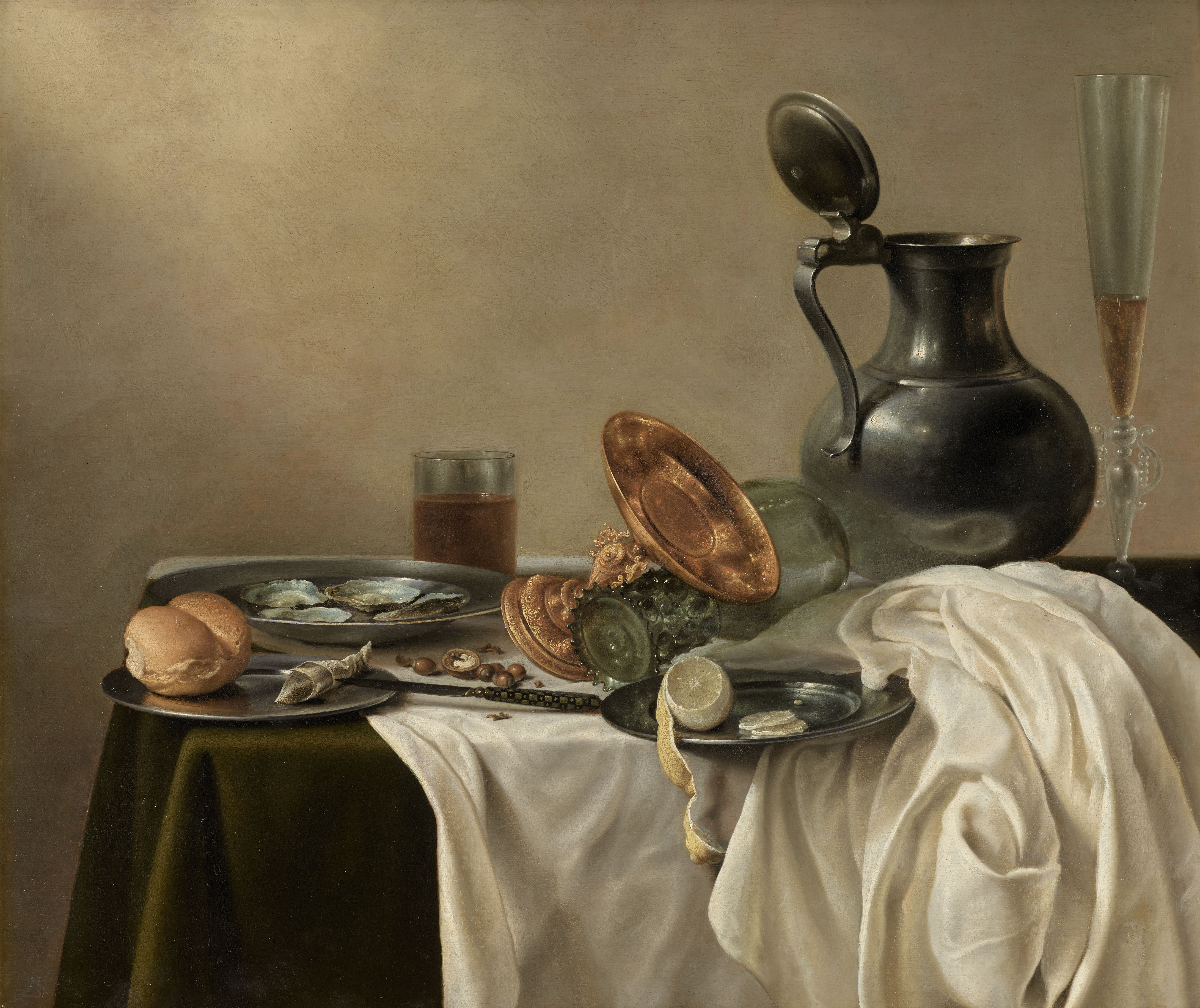
A Still Life with a Gilt Tazza, Pewter Jug, and a Fluted Wine Glass
With Kunsthandel Douwes, Amsterdam;
From whom acquired bya private collector, the Netherlands, 1955;
And thence by descent, until 2025.
...
N.R.A. Vroom, A modest message as intimated by the painters of the ‘monochrome banketje’, vol. II, Schiedam 1980, p. 147, cat. No. 760, reproduced (as Adriaen Kraen).
M. Brunner-Bulst, Pieter Claesz. der Hauptmeister des Haarlemer Stillebensi m 17. Jahrhundert, Lingen 2004, p. 172-175, cat. No. 62, reproduced
...
1635 – the year which Pieter Claesz dated this still life in his signature – marks a period of renewed activity in the artist’s career. A beam of light entering from the upper left illuminates a precariously arranged assortment of objects on a table, covered with a dark moss-green cloth and a white linen tablecloth. The composition is dominated by ...
While the wine and beer, bread, lemon, oysters and nuts suggest the remains of a simple meal, the costly tazza, the finely wrought knife, and sophisticated drinking vessels denote a wealthy household. Claesz’s rendering of the various materials on display is masterful, as is his treatment of the reflections in the metal and glass objects. The pewter plate perched haphazardly on the edge of the table, the dangling curl of lemon peel, and the cascading folds of white linen create a powerful illusion of dimensionality, as if the objects might fall into our laps. By confining himself to closely attuned shades of grey, brown, ochre, and green, with only a few accents of color in the golden tazza and the citrus peel, Claesz created a particularly harmonious effect.
Relatively little is known about the early life of Pieter Claesz. He was born in 1596 or 1597 in Berchem, a village near Antwerp, and probably received his training in Antwerp from a local master. When he was in his early twenties, he moved to Haarlem and remained there for the rest of his life. Claesz devoted himself exclusively to still lifes, mainly breakfast and banquet pieces, but also some still lifes with smokers’ requisites and vanitas motifs. Fortunately for art historians, he consistently monogrammed his works, as he did in the present work, and dated many of them, thereby providing a clear record of his stylistic development from 1621 to 1660.
Claesz’s early still lifes are closely related to the still lifes of laid tables painted by the first generation of Haarlem still-life painters, such as Floris van Dijck (c. 1575-1651), Nicolaes Gillis (c. 1612-1632), and Floris van Schooten (c. 1585/88-1656). However, in collaboration with fellow townsman Willem Claesz Heda (1594-1680), towards 1630 Pieter Claesz developed a new type of still-life painting – the so-called monochrome bancketje (monochrome banquet piece) – characterized by a striking simplicity and renunciation of color variations. In these austere and refined works of his early maturity, Claesz showed himself to be an outstanding master at capturing the effects of light and atmosphere and describing the textures of diverse objects. Later in the 1630s, he began to tackle larger, more elaborate compositions, which nonetheless remained faithful to the tonal style, as is the case in the present painting. After about 1640, his pictures became somewhat less monochromatic again and he developed a more painterly manner.
It was not only that Heda and Claesz’s aesthetic tastes developed together, but also their predilection for specific arrangements and objects. They may have even shared studio props between the two workshops, as near-identical vessels appear in the two painters’ works. The move by Claesz towards a greater monumentality was likely stimulated by contact with the work of the Amsterdam still-life specialist Jan Jansz den Uyl (1595/96-1639/40). We do not know whether Claesz knew Den Uyl personally, but he and Heda must have been familiar with examples of Den Uyl’s still lifes from around 1632/33, which often included a large pewter jug, a flute glass and an overturned tazza, motifs which we see replicated in the present work.
1635 – the year which Pieter Claesz dated this still life in his signature – marks a period of renewed activity in the artist’s career. A beam of light entering from the upper left illuminates a precariously arranged assortment of objects on a table, covered with a dark moss-green cloth and a white linen tablecloth. The composition is dominated by a large, bulbous pewter jug, standing on the right, with its lid wide open; close beside it stands a tall, elegant flute glass partially full of wine. Appearing to the left is a gilt tazza resting on top of an overturned glass rummer, a tumbler of beer and three pewter plates bearing oysters, a bread roll, a cone of paper containing grains of pepper, and a partly peeled and sliced lemon. A crumpled linen napkin, a knife and a handful of cracked nuts complete the arrangement. The scale of this unusually large painting suggests the artist’s reinvigorated professional ambitions at this very moment.
You may also like
Pieter Claesz
(Berchem 1597 - Haarlem 1661)
“A Still Life with a Gilt Tazza, Pewter Jug, and a Fluted Wine Glass”
Sebastiaen Vrancx
(Antwerp 1573 - Antwerp 1647)
“Winter Carnival with Ice Skaters in front of the Kipdorppoort Bastion in Antwerp”


