 Facebook
 Twitter


 Gmail
Angelica Kauffman
(Chur, Graubünden 1741 - Rome 1807)
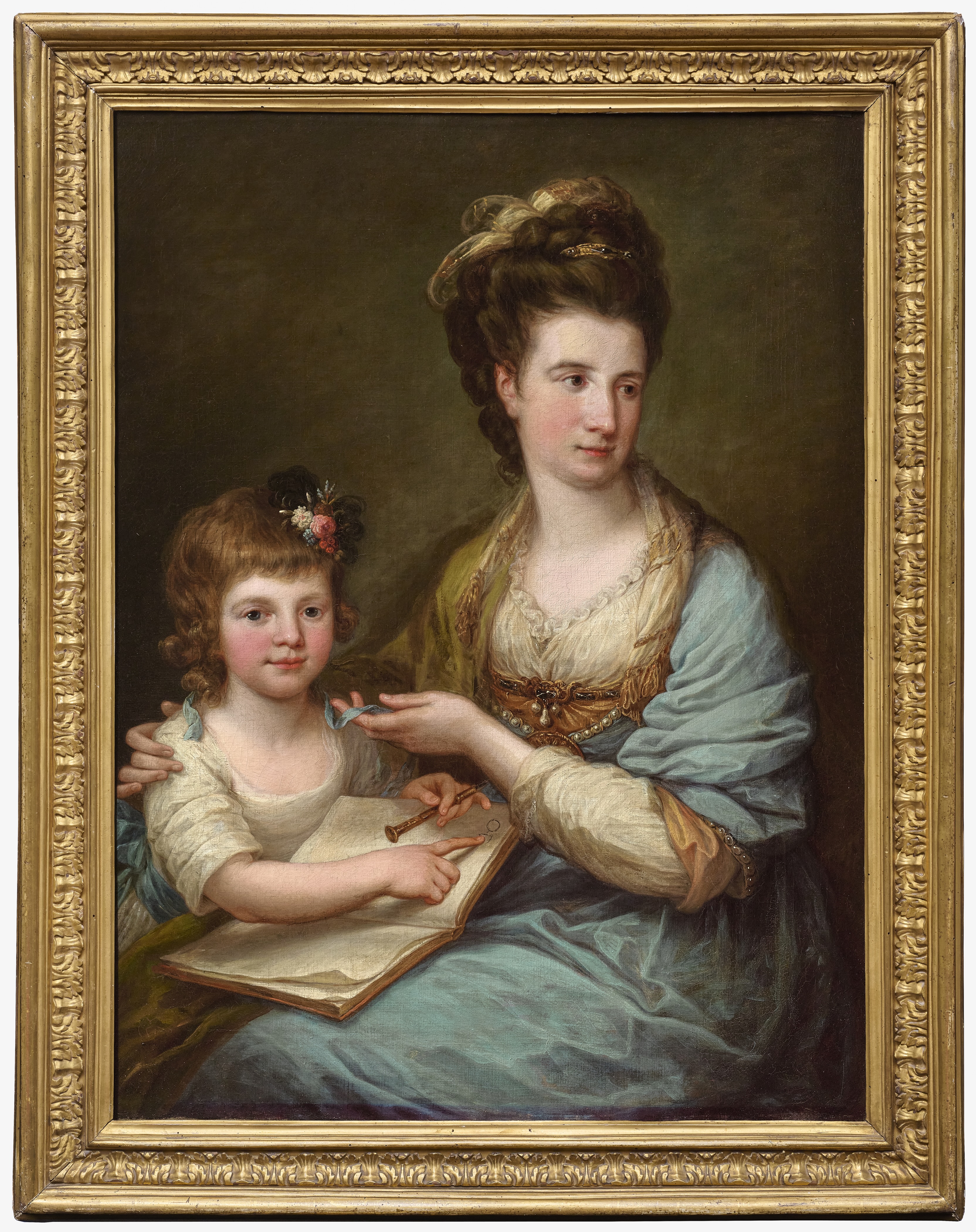
Portrait of Anne Stewart, née Dashwood, later Countess of Galloway (1743-1830), with her daughter, Lady Susan Stewart, later Duchess of Marlborough (1767-1841)
By descent from the sitter at Galloway House, Galloway and Cumloden House, Dumfries
...
Anne Stewart, Countess of Galloway, was the third daughter of Sir James Dashwood, 2nd Bt., M.P. (1715–1779) and his wife, Elizabeth Spencer. The Dashwoods were a prominent and prosperous landholding family in Oxfordshire, where Sir James built an imposing house at Kirtlington Park whose Rococo dining room is now in the Metropolitan Museum of Art. In 1764, Anne became ...
The youthful Lady Susan Stewart, who accompanies her mother in the present portrait, was the couple’s third child. In 1791, she married George Spencer Churchill, Marquess of Blandford, later 5th Duke of Marlborough, with whom she had likely become acquainted as the two families were close neighbors. The duke, though a prolific collector of early books, was not a faithful husband. By contrast, the duchess, who became mistress of Blenheim Palace upon her husband’s ascent to the dukedom, was much beloved, cherished by her children and grandchildren, and ultimately numbered among her numerous descendants her great-great-grandson, Sir Winston Churchill.
In contrast with Reynolds’ winsome portrait of a young woman on the verge of marriage, Angelica Kauffmann shows Anne Stewart both as mature lady of status and as a devoted mother. Anne gently drapes one arm around Susan’s shoulders and fondles the girl’s blue hair ribbons, matching the sash of her white frock, with her opposite hand. Susan, whose red curls are prominently adorned with a sprig of bright flowers and dark feathers, gestures to an open leatherbound sketchbook that rests upon her mother’s lap with one hand and holds a stylus in the other, pointing with one finger and evident pride towards the childish scrawl she has made on the page. Particularly adept at conveying the relaxed, tender relations between mothers and their children with naturalism and simplicity, Kauffmann brought an especially feminine and maternal sensibility to intimate family portraits like this one. Likewise, perhaps the young Susan’s mother enjoyed encouraging her daughter’s nascent attempts at drawing, a ladylike pastime, and wished to feature this particular precocity. Kauffmann, who frequently included leatherbound notebooks and styluses, the tools of her trade, in her own self-portraits, may have been pleased to include these details in an aristocratic portrait, which in turn ennobled her own enterprise. While Lady Susan would never have been expected to pursue any profession, the girl’s clear pleasure in her scrawls may moreover have endeared her to Kauffmann who likewise practiced her art from her early childhood.
Like many of Kauffman’s female portraits, the present work depicts Anne in a seated pose and attired in elegant dress, her torso turned as she gazes to the side, while her daughter meets the viewer’s gaze directly. In many of her portraits, especially those of her English period, Kauffmann chose to present her sitters in costumes deriving from two distinct cultural influences, namely timeless all’antica garb and orientalising turquerie, the fashion for imitating aspects of the culture of the Ottoman Empire found in dress, painting, music, and décor. In her Turkish Embassy Letters (1716–18, published in 1763), Lady Mary Wortley Montagu, the wife of the British Ambassador at Constantinople, had sparked a fashion for all things Turkish. Although Kauffmann had not travelled in Turkey, she nevertheless embraced the trend and as a painter of choice for the stylish elite was inundated with commissions for portraits à la turque, which appropriated, appreciated, and elaborated Middle Eastern designs.
Here, Kauffmann flatters one such elegant patroness with painterly virtuosity and expensive, exotic, if stylized, flair. Anne is shown wearing a gömlek, a simple dress of gauzy white silk, ruffled at the neck, and secured at the bustline with a gold satin band embellished with elaborate gold, pearl, and jet jewels. Over this she wears an entari, a loose, shorter-sleeved blue silk robe edged in gold brocade around the neck, adorned with pearls at the sleeve, and draped there so as to reveal its pink silk lining. The entari is pulled tight at the waist, lined with pearls as at the sleeves, and secured with a large gold medallion, much like ones found at the waists of similar garments, sometimes in pairs. Although in other portraits by Kauffmann in which sitters are costumed à la turque the entari flows more freely, perhaps in the case of Anne Stewart, the elaborate fastening of the gömlek and the entari, along with the positioning of her left arm and her daughter’s sketchbook, sought to conceal the progress of one of her frequent pregnancies. A diaphanous, gauzy scarf shot through and fringed with gold is woven into the curls piled atop her head and falls around her shoulders, while a small golden headpiece set with three pieces of black jet echoing the jewels at her waist holds her coiffure in place at the front. A swath of light green fabric is draped over her right shoulder, falling onto her lap beneath the sketchbook, perhaps to protect her finery from any soiling, or is perhaps a simple shawl placed around the entari, as in Kauffmann’s portrait of Elizabeth Bateson (née Harvey) à la turque (ca. 1770), or the Woman in Turkish Dress (ca. 1771–74), which compares closely with the present painting.
Given Lady Susan’s age, likely of around three or four, at the time of the painting’s facture, a date around 1770 or 1771 seems appropriate for the work. We are grateful to Dr. Bettina Baumgärtel and Professor Wendy Wassying Roworth who independently confirmed the attribution following inspection of the original in 2014.
Anne Stewart, Countess of Galloway, was the third daughter of Sir James Dashwood, 2nd Bt., M.P. (1715–1779) and his wife, Elizabeth Spencer. The Dashwoods were a prominent and prosperous landholding family in Oxfordshire, where Sir James built an imposing house at Kirtlington Park whose Rococo dining room is now in the Metropolitan Museum of Art. In 1764, Anne became the second wife of John Stewart, Lord Garlies, later the 7th Earl of Galloway (1736–1806), who had been painted in miniature by Nathaniel Horne and later in Van Dyck costume by Mengs in Rome in 1758. In the three weeks prior to her marriage, Anne herself sat for Joshua Reynolds four times, resulting in a three-quarter length portrait of the bride as a shepherdess, a costume popular for masquerades and country outings, while a relief at the painting’s right shows an amorous subject, Cupid Awaking Psyche, alluding to the sitter’s impending nuptials. Stewart succeeded to the title of Lord Galloway upon the death of his father in 1773, inheriting Galloway House, designed by Robert Adam, as well as extensive estates in Wigtonshire, Scotland. The couple had sixteen children.
You may also like
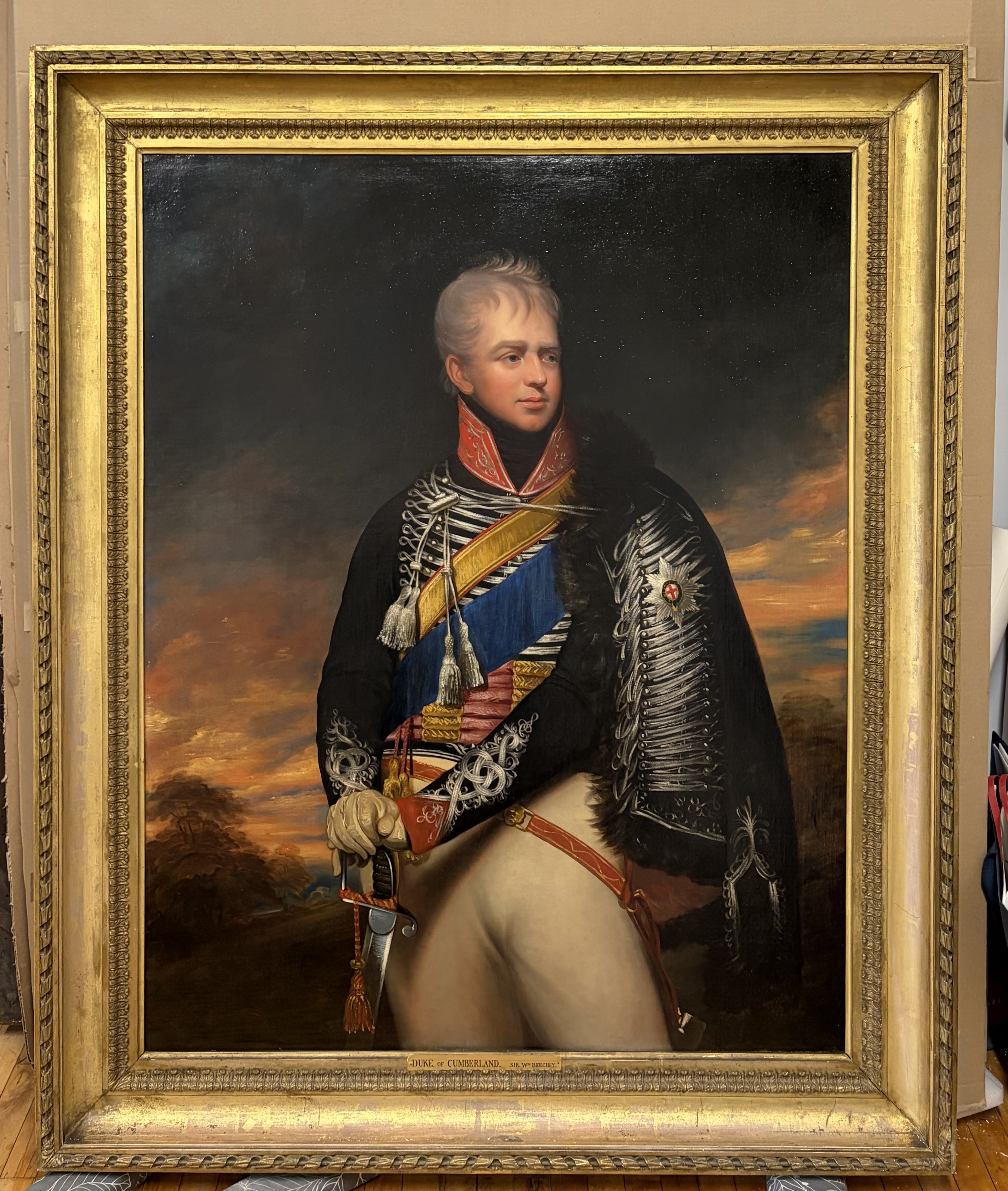
Sir William Beechey
(Burford 1753 - London 1839)
“Ernest Augustus, Duke of Cumberland, King of Hanover (1771-1851), Half Length, Looking Left, in Hussar Uniform”