 Facebook
 Twitter


 Gmail
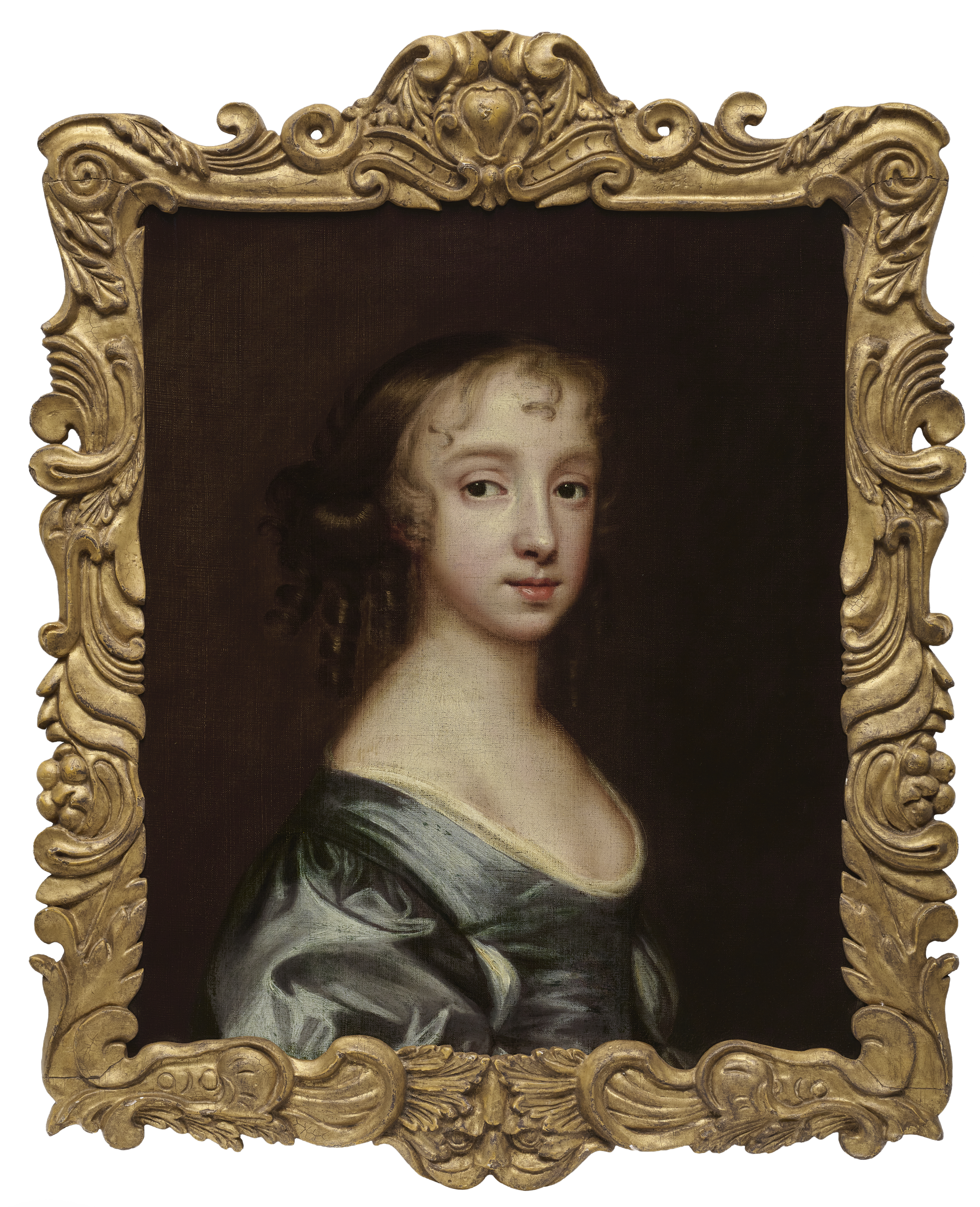
Mary Beale
(Barrow, Suffolk 1633 - London 1699)
Portrait of a Girl in Blue Satin Dress
Warner Ottley;
By whom sold ("The Property of Warner Ottley, Esq."), Christie's London, 30 June 1961, lot 17 (as Follower of Lely, Portrait of Mrs. Sackitt);
Where acquired by "Nicholls";
With Newhouse Galleries, New York (according to a label on the verso);
Pola Negri (1897-1987), San An
...
The English portrait painter Mary Beale (née Cradock) (1633–1699) was one of only a handful of female professional artists working in London in the seventeenth century. Primarily known for her portraits, Beale was praised as a “virtuous” practitioner in “Oyl Colours” by Sir William Sanderson in his 1658 book Graphice: The Use of Pen and Pensil ... . The painting at hand demonstrates why Beale became such a sought-after portraitist. The sitter turns to face us, her dark eyes peering out at the viewer. Her rosy lips curve gently upwards, the beginnings of a smile complemented by her rosy cheeks. Her elegantly-coiffed hair, with curls framing her oval face, catches the light illuminating the sitter. She is dressed in a fashionable blue satin gown, rendered with quick strokes of the brush. Though we do not know her identity, Beale’s portrait nonetheless presents us with a sense of the sitter’s presence and personality. The present work is suggestive of Beale’s success in London, which was posthumously memorialized through her inclusion in Bainbrigg Buckeridge’s “An essay towards an English School” (1706), where she praised for her “Colouring, Strength, Force [and] Life.”
Born in Barrow, Suffolk, Mary’s father John Cradock (d. 1652) was the rector of All Saints Church in the village as well as an amateur painter. It was likely John who first instructed Mary in painting, and who perhaps introduced her to the colony of well-known painters working close by in Bury St Edmunds, including Sir Peter Lely (1618-1680), Matthew Snelling (1621-1678), and Robert Walker (1607-1658).
In 1652, at the age of eighteen, Mary married Charles Beale (1632-1705). Also an amateur painter, Charles Beale was aCivil Service clerk, who in 1660 succeeded his father as deputy clerk of the patents office. However, Mary's success grew quickly, and her husband became manager of the successful studio while Mary became the primary financial provider for the family. Throughout their marriage, Mary and Charles worked together as equals and as business partners, an incredibly unusual arrangement at the time. It is thanks to Charles’s detailed notebooks that we can understand their working relationship, Mary’s commissions, and her artistic experiments.
She was especially fortunate to have as a good friend Sir Peter Lely, who succeeded Anthony van Dyck (1599-1641) as the court painter. He took great interest in Mary's progress as an artist, and she would practice painting by imitating some of his work. In addition to offering Mary the opportunity to visit his studio, Lely would also visit the Beale home on occasion to observe Mary paint and praise her work. The Beales also commissioned portraits from Lely, of themselves and their friends. Her near-contemporary George Vertue (1684–1756) records that Lely's portraits of Mary and her family were present at their home at Hind Court in 1661.
In addition to her work as a painter, Mary Beale was also an accomplished writer, whose prose Discourse on Friendship(1666) presented a scholarly exploration of the subject from a uniquely female viewpoint. Her 1663 manuscript, Observations, explored the materials and techniques she employed “in her painting of Apricots.” Although her text was not printed, it did circulate and is the earliest known instructional text on oil painting in English written by any author, male or female.
The English portrait painter Mary Beale (née Cradock) (1633–1699) was one of only a handful of female professional artists working in London in the seventeenth century. Primarily known for her portraits, Beale was praised as a “virtuous” practitioner in “Oyl Colours” by Sir William Sanderson in his 1658 book Graphice: The Use of Pen and Pensil, or The Most Excellent Art of Painting. The painting at hand demonstrates why Beale became such a sought-after portraitist. The sitter turns to face us, her dark eyes peering out at the viewer. Her rosy lips curve gently upwards, the beginnings of a smile complemented by her rosy cheeks. Her elegantly-coiffed hair, with curls framing her oval face, catches the light illuminating the sitter. She is dressed in a fashionable blue satin gown, rendered with quick strokes of the brush. Though we do not know her identity, Beale’s portrait nonetheless presents us with a sense of the sitter’s presence and personality. The present work is suggestive of Beale’s success in London, which was posthumously memorialized through her inclusion in Bainbrigg Buckeridge’s “An essay towards an English School” (1706), where she praised for her “Colouring, Strength, Force [and] Life.”
You may also like
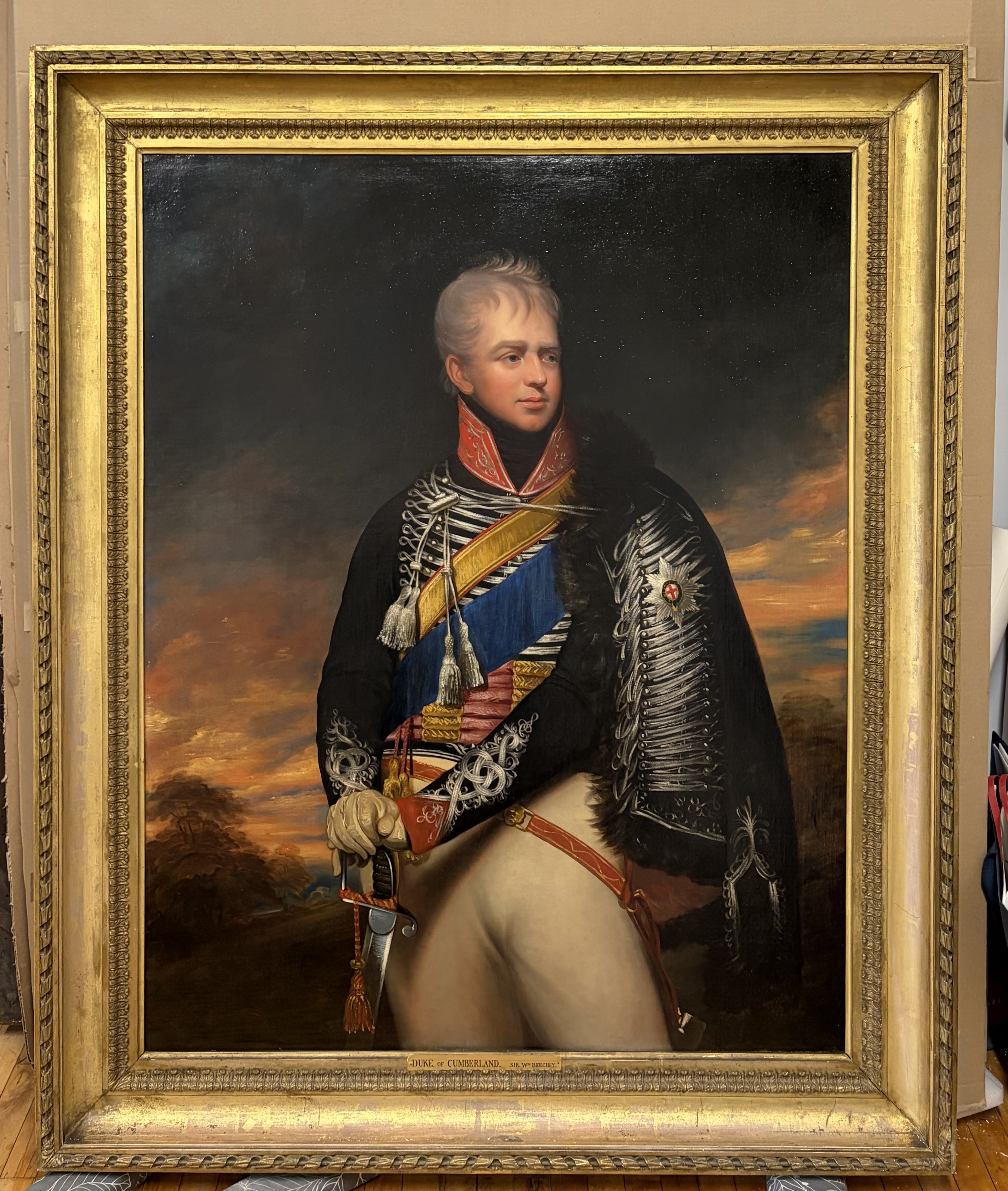
Sir William Beechey
(Burford 1753 - London 1839)
“Ernest Augustus, Duke of Cumberland, King of Hanover (1771-1851), Half Length, Looking Left, in Hussar Uniform”