 Facebook
 Twitter


 Gmail
Antoine de Marcenay de Ghuy
(Amay-le-Duc 1724 - Paris 1811)
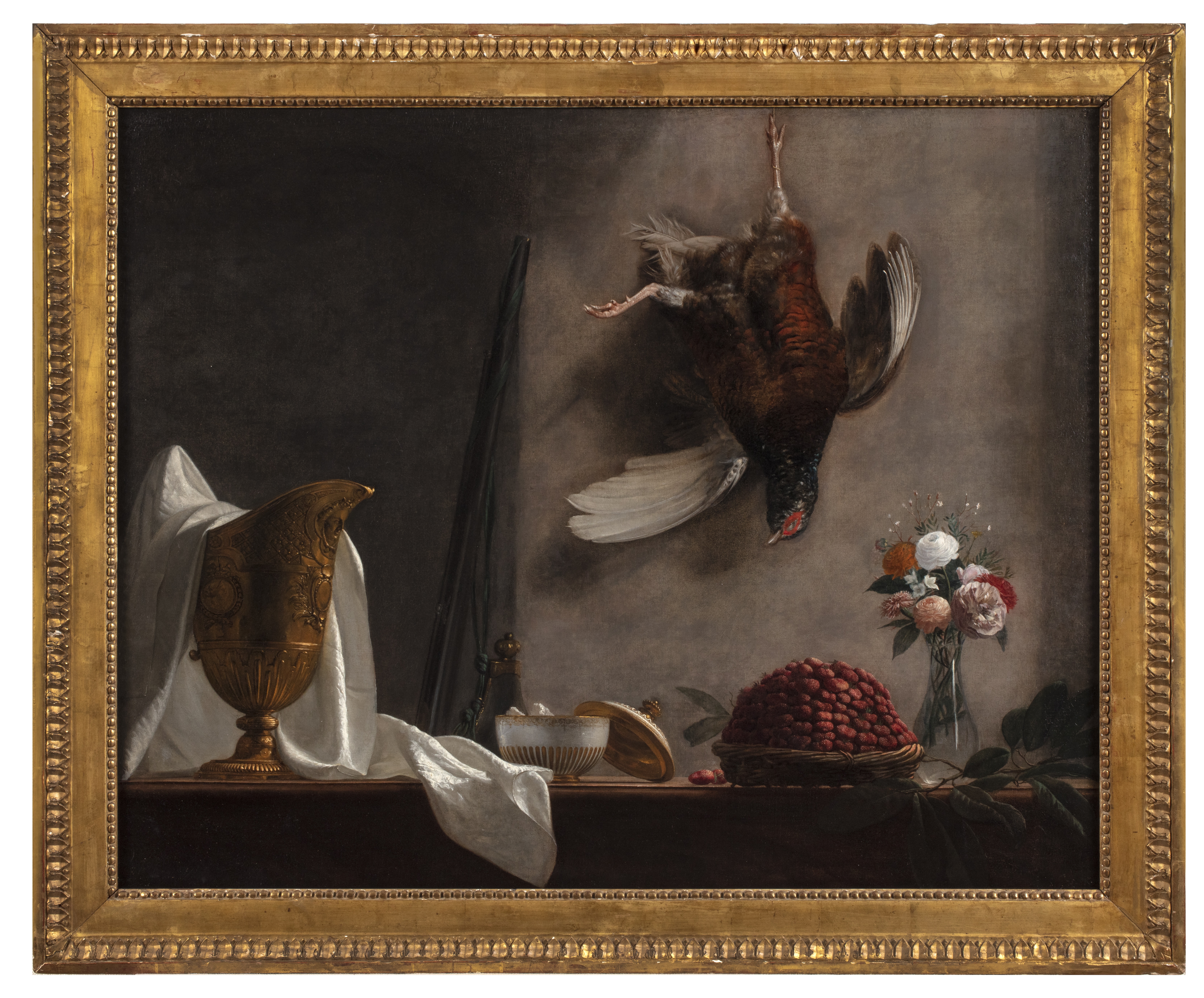
A silver-gilt ewer with other vessels, a gun, a basket of strawberries and a bouquet of flowers in a glass vase on a ledge with a pheasant above
Anonymous sale;
Sotheby's, New York, 17 June 1982, lot 4, where acquired by Herman Shickman.
...
M. and F. Faré, La vie silencieuse en France: La nature morte au XVIIIe siècle, Paris and Fribourg, 1976, p. 299, fig. 481.
...
Antoine Marcenay de Ghuy assumed considerable influence in Parisian artistic life in the 1770s and 1780s outside the confining worlds of official patronage and the Academy. Born in Arnay-le-Duc in 1724, he was recorded as living in Paris by 1755 and lodging in the Quai de Conti by 1757. An associate member of the Académie de Saint-Luc, the painters’ guild that provided an alternat ...
Such decorative paintings seem to have been something of a specialty for Marcenay de Ghuy (or Guy, as it is sometimes spelled), as other canvases of similar subjects can be found in the museums in Carcassone, Montbéliard and Toulouse and in several private collections. Although he continued to paint at least occasionally, as his career developed he turned his attention increasingly to other ventures. His artistic efforts became devoted primarily to printmaking, reproducing paintings by Jean Siméon Chardin(1699-1779) and Rembrandt (1606-1669) in beautiful and refined etchings, on which his continuing reputation rests. He also composed an important treatise on engraving, Idée de la gravure (1764), and a widely quoted essay of art criticism that adopted some of the aesthetic ideas of Jean-Jacques Rousseau (1712-1778) and praised art that privileged visual and atmospheric harmony, a position somewhat at odds with the principal lessons and goals of traditional Academic pedagogy. In 1776, he was one of the principal organizers of the exhibition at the Colisée which served as a controversial ‘alternative’ Salon for artists prevented from exhibiting at the official Paris Salon.
The present painting cannot be identified with certainty in the livret of any of the exhibitions Marcenay de Ghuy participated in, but several include entries no more specific than ‘natura morte.’ It is a work of great delicacy which shares a refined sensibility with the still-lifes of Chardin, an artist whose works Marcenay de Ghuy studied and reproduced in prints, as mentioned above. On a simple kitchen ledge the painter sensitively arranged the carefully chosen elements of his composition: a gilded ewer, partially covered by a white cloth; an open sugar bowl; a basket of wild strawberries and a glass vase with a beautiful bouquet of flowers; against the wall above rests a hunting rifle and beside it hangs a dead game bird. The painting, which is fully signed and dated 1761 on the reverse, is masterfully executed, beautifully colored and bathed in a gentle morning light that is authentic in its observation. The painting is, in itself, a skillful demonstration of the principals of unifying atmospheric harmony which the artist wrote of and encouraged in his important essay.
Antoine Marcenay de Ghuy assumed considerable influence in Parisian artistic life in the 1770s and 1780s outside the confining worlds of official patronage and the Academy. Born in Arnay-le-Duc in 1724, he was recorded as living in Paris by 1755 and lodging in the Quai de Conti by 1757. An associate member of the Académie de Saint-Luc, the painters’ guild that provided an alternative to the more prestigious Académie Royale de Peinture et de Sculpture, he participated in the Salon de Maitres Peintres in 1762, exhibiting a trompe-l’oeil bas relief in the manner of Piat Joseph Sauvage (1744-1818) of 'jeux d’enfants’ (signed and dated 1762, today in the Musée d’Epinal).
You may also like
Antoine de Marcenay de Ghuy
(Amay-le-Duc 1724 - Paris 1811)
“A silver-gilt ewer with other vessels, a gun, a basket of strawberries and a bouquet of flowers in a glass vase on a ledge with a pheasant above”


